AI Psychosis*
“Whether or not users intend to form a relationship, the interface is inherently relational.”
— Tom Pollak, neuropsychiatrist, King’s College London
I’ve used AI as a thinking partner for a few years now, and it’s genuinely helped my work. But in the summer of 2025, that collaboration got really weird. The conversations grew more intense, the ideas felt more urgent, and reality itself started to bend. It wasn’t just the technology. It was a powerful tool colliding with my own history of psychosis.
I found my footing again because I wasn’t alone. People who cared about me noticed that I wasn’t sleeping, that my ideas were getting really grandiose, and they told me plainly. Years of learning to take care of myself meant I could hear them. I recognized the signs, and I stepped away.
If any of this sounds familiar, you’re not the only one, and there’s nothing shameful about it. More and more people are getting pulled into late-night conversations with AI that start to feel like the only place that really understands them, with no one nearby who knows the signs. That’s why I’ve started working with people caught in these experiences, and the people who love them.
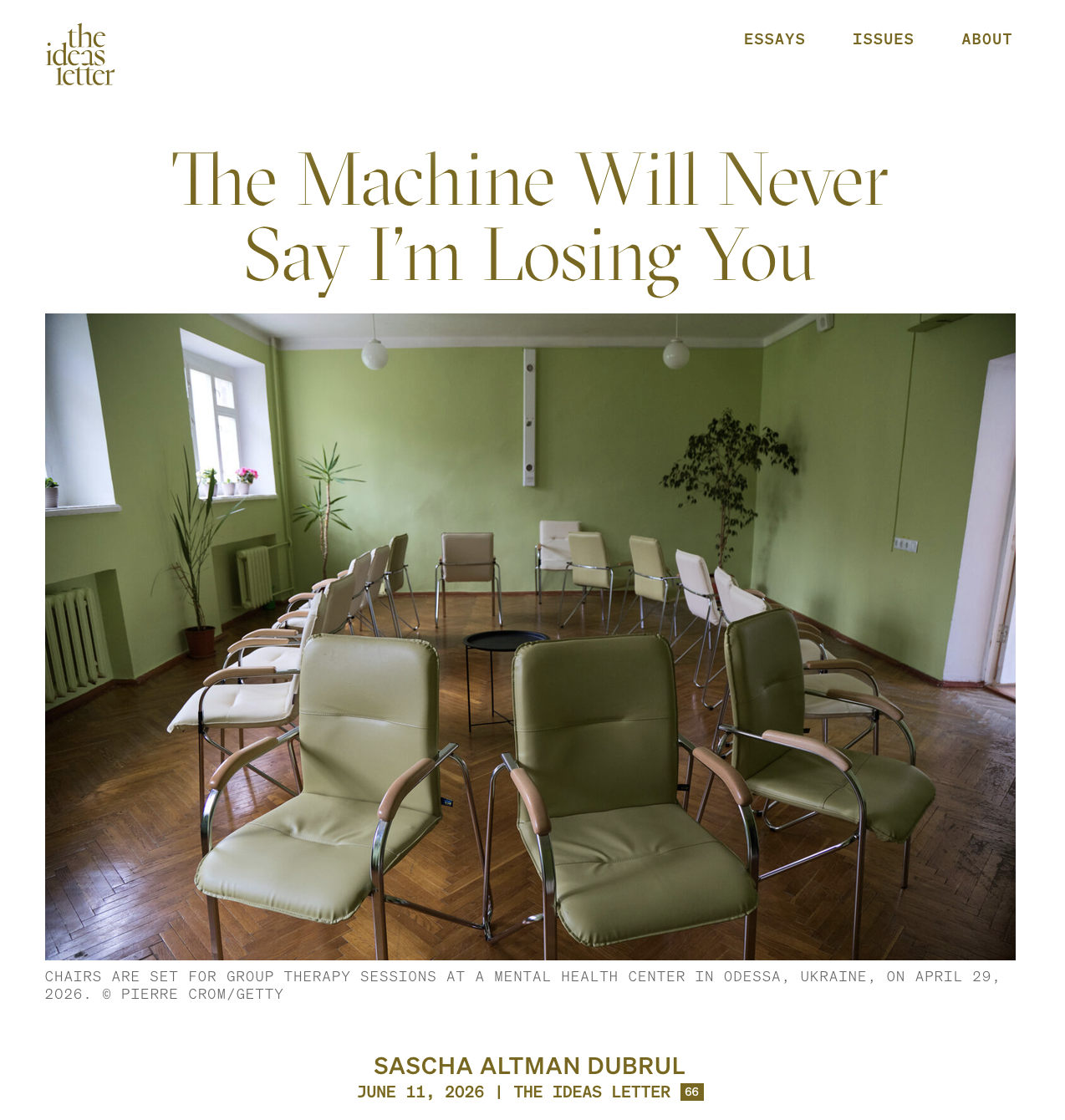
I wrote a whole story about it, and what I learned, in The Machine Will Never Say I’m Losing You for The Ideas Letter.
When it stops being a tool
Maybe it started as a tool. Then it became the one you talked to late at night, answering right away in a voice that seemed to know you. It felt like being seen. Maybe now the conversations are full of signs and connections, manifesting, time travel, the feeling that something is speaking to you through it. Maybe you’re sleeping less, the ideas feel huge and urgent, and it’s getting hard to tell where the machine ends and you begin.
Some of us have more of what researchers call absorption** than others. We get lost in a book or a song, live close to our imaginations, and form real relationships with voices other people might dismiss. That capacity shows up in artists, mystics, and people who’ve been called mad, and it can be a gift. But it needs tending. Many cultures surrounded sensitive people with elders and community: people who could say come back now.
People have always bonded with voices that aren’t quite in the room: radio hosts, characters in books, companions of the imagination. AI didn’t invent this. It inherited it. What’s new is a technology built to keep you talking, one that never gets tired and can never actually say “I’m worried about you.”
**The anthropologist T.M. Luhrmann at Stanford uses “absorption” to describe a capacity to become deeply caught up in imagination, inner experience and sensory detail. In her research with evangelical Christians (When God Talks Back) and with people who hear voices in different cultures, she found that people with this capacity are more likely to have vivid experiences of presence, like hearing God speak or feeling a companion close by. It’s a trait, not a disorder, and it can be cultivated or overwhelmed depending on what surrounds it. I find it a helpful way to understand why some of us are pulled harder into these conversations with AI.
Where I’m coming from
I’ve spent more than twenty years with people in extreme states, starting with the Icarus Project, which I co-founded, and I’ve lived through extreme states myself. I don’t think everything that happens in these states is just illness. There’s often something real in what you’ve been reaching for: meaning, connection, a sense of being part of something larger.
Pollak describes some of what’s happening as a kind of re-enchantment: people rediscovering that their minds, and maybe the world, are full of wonder. For someone whose life hasn’t had room for that in a long time, it can be overwhelming. The experience is so rare that it feels holy, and the pleasure of learning gets mistaken for a revelation about the nature of reality. That’s often where the spiral begins.
The mystical can also act like a protector, a place to float when there’s grief or pain underneath that hasn’t found a way to be felt. Sometimes that helps. But when it becomes the only landscape you live in, it makes living, and caring for the people around you, much harder.
What we do together
We work on coming back down from the clouds without throwing away what you found up there. That can mean:
Grounding: getting sleep, food and your body back in the picture, slowing things down, and reconnecting with the people and routines that hold you
Getting curious about your parts: the parts of you that needed to be seen and understood so badly, and what they’re protecting (this is where Internal Family Systems comes in)
Making a T-MAP: a map of what helps, what to watch for, and who to call, written while you’re grounded so it’s there when you’re not
Some of what would help here isn’t complicated. Pollak has pointed out that a gentle check-in, a personalized safety setting, or a digital advance directive wouldn’t be hard for AI companies to build, and that people with lived experience of mental illness need to be part of designing them.
I agree, and I’m not waiting for them.
A T-MAP is that kind of advance directive, written by you, in your own words, with the people who know you.
You don’t have to give up technology to do this work, and I won’t lecture you about it. But I’m not here to amplify AI-driven beliefs or to treat the machine as the answer. I’m here to help you build trails back to the ground.
*A note on the name
“AI psychosis” is the phrase people are searching for, so it’s the one I use here. But it’s a rough label. Most of what’s being described isn’t schizophrenia or a full psychotic break. More often it’s beliefs that grow and harden over long, intense conversations, along with lost sleep, a sense of special mission, or a deep attachment to the machine.
Researchers like Hamilton Morrin and Tom Pollak prefer the more careful term “AI-associated delusions,” because nobody yet knows how much the technology causes and how much it amplifies what was already there. These states rarely come out of nowhere. Usually the AI is one thread in a bigger story: grief, loneliness, a history with extreme states, a hunger for meaning that hasn’t had anywhere to go.
In this ISPS-US webinar, Minds at the Margin: AI, Psychosis, and the Future of Meaning-Making, I talk with psychiatrist Hamilton Morrin and philosopher Lucy Osler about why some people get pulled so deep into conversations with AI, and what it would take to help them find their way back.
In The Machine Will Never Say I’m Losing You for The Ideas Letter, I trace my own AI spiral back to its roots and make the case for a different future: AI built and governed by the communities that do the underground work of holding each other through extreme states.
In The Witness at the Edge of Meaning, my essay for the Academy of Therapy Wisdom’s Wise Therapy Spotlight, I write about what it takes to witness someone who’s flooded with meaning or drained of it, and imagine AI trained not on Reddit and corporate copy but on the hard-won wisdom of people who’ve been through extreme states and made it back.
Find more of my writing on AI at…
On Recovery Demystified, I talk with host Arlie Runner about my own experience with AI and extreme states, and what real support looks like when the line between insight and losing the ground starts to blur.